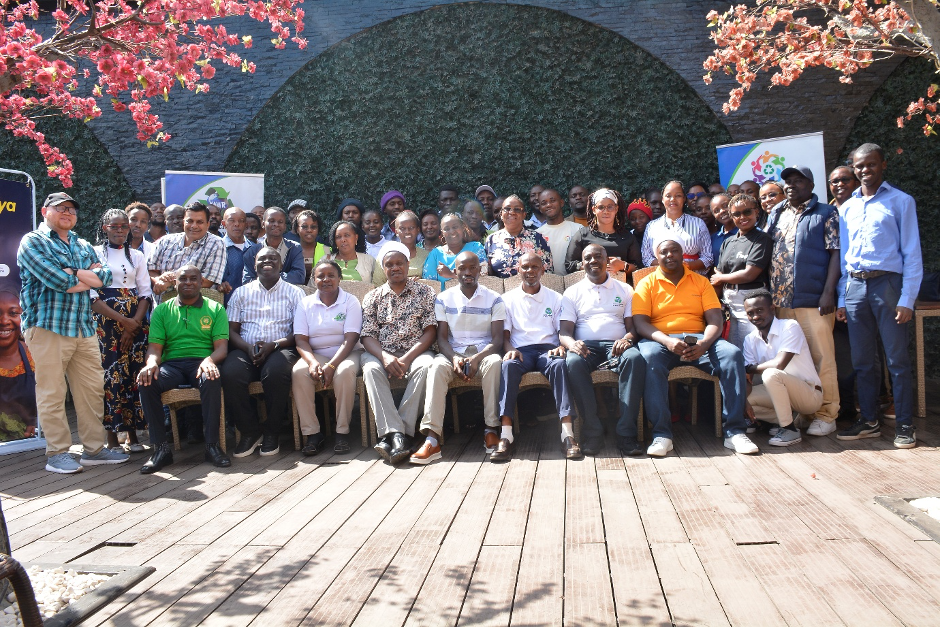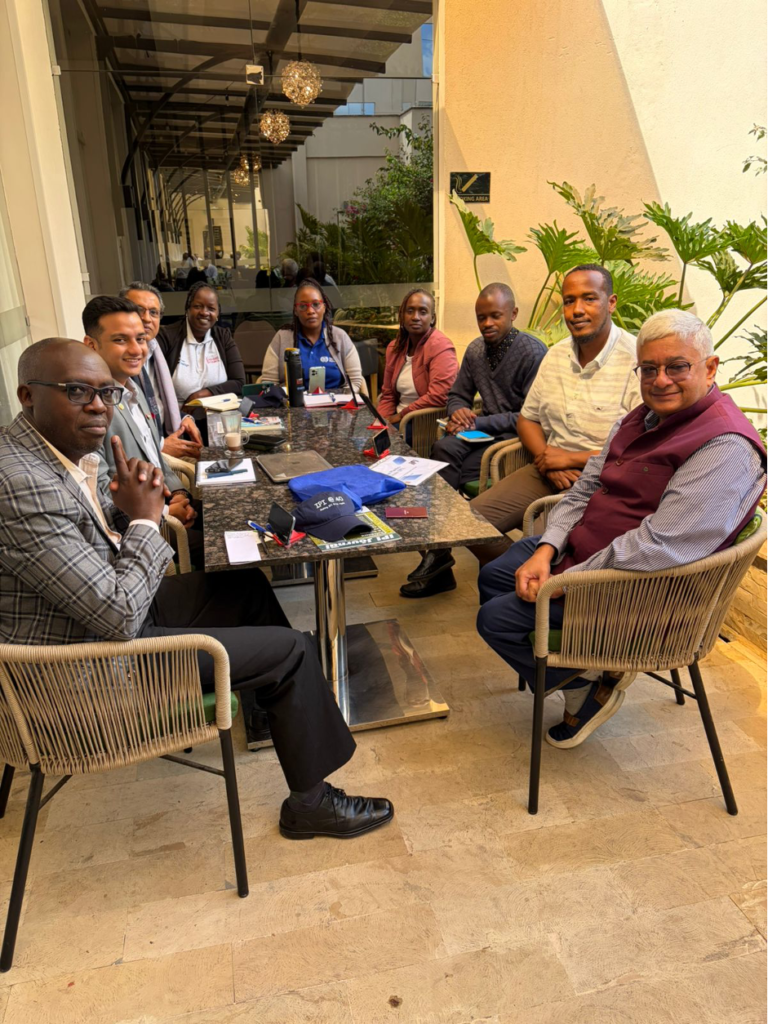
From the left; Josphine Kawira(DRC), Hellen Chege(DRC), Yasin Abukar(My-Plastics Ltd.), Richard Kainika (KAWR), Dr. Sameer Joshi( IPI), Shabbir Noormohamed(My-Plastics Ltd.),Joan Maitai( DRC),  Sharang Ambadkar (IPI).

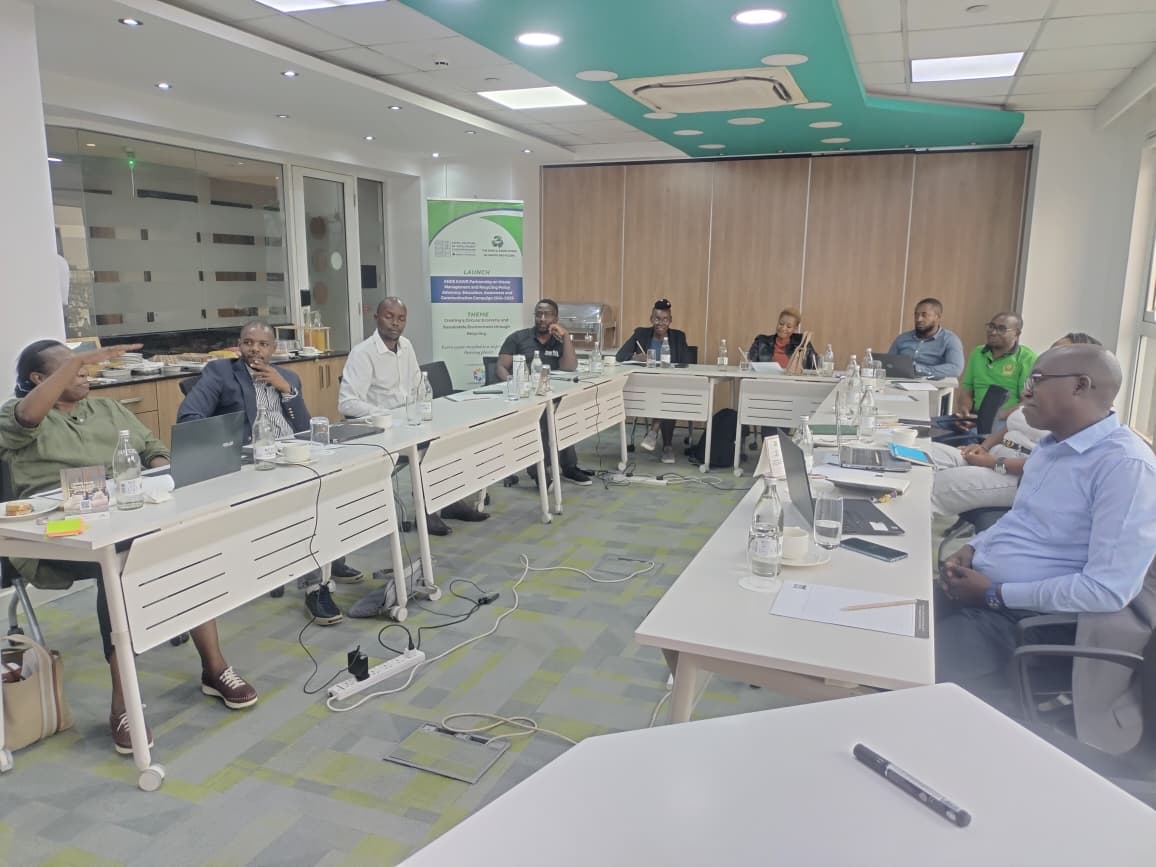
Kenya Association of Waste Recyclers (KAWR) was honored to hold a working meeting with the Indian Plastics Institute (IPI) at the Double Tree by Hilton along Ngong Road, Nairobi. Registered in 1985, IPI is a professional body that brings together experts, industry players, and students involved in plastics and polymer technology. It focuses on strengthening skills through training, technical courses, seminars, and industry–academia collaboration. The institute also contributes to standardization efforts, quality control, and public awareness on plastics, their applications, and recyclability.

Also present at the meeting were representatives from the Danish Refugee Council (DRC) Kenya and My Plastics Limited.

The meeting concentrated on the shared objectives between KAWR and IPI—specifically opportunities and challenges within Kenya’s waste-management sector. Dr. Sameer Joshi, Chairman of the Indian Plastics Institute and a respected expert in plastic sustainability with over 30 years of experience, shared insights on India’s progress in plastic circularity. India has made notable strides by applying its strong technological capacity to develop solutions for low-value and hard-to-recycle plastics, including multilayer laminates. Through IPI’s work, such materials have been transformed into products such as planks, plywood alternatives, benches, tiles, and other utilities that replace higher-carbon-footprint materials. These solutions were further demonstrated by Mr. Sharang Ambadkar, a member of the IPI Environment & Ecology Committee and Sustainable Solutions for All.

This discussion was particularly relevant to Kenya, where hard-to-recycle packaging materials remain a persistent challenge. While local efforts exist, many of them require scaling to meet national needs.

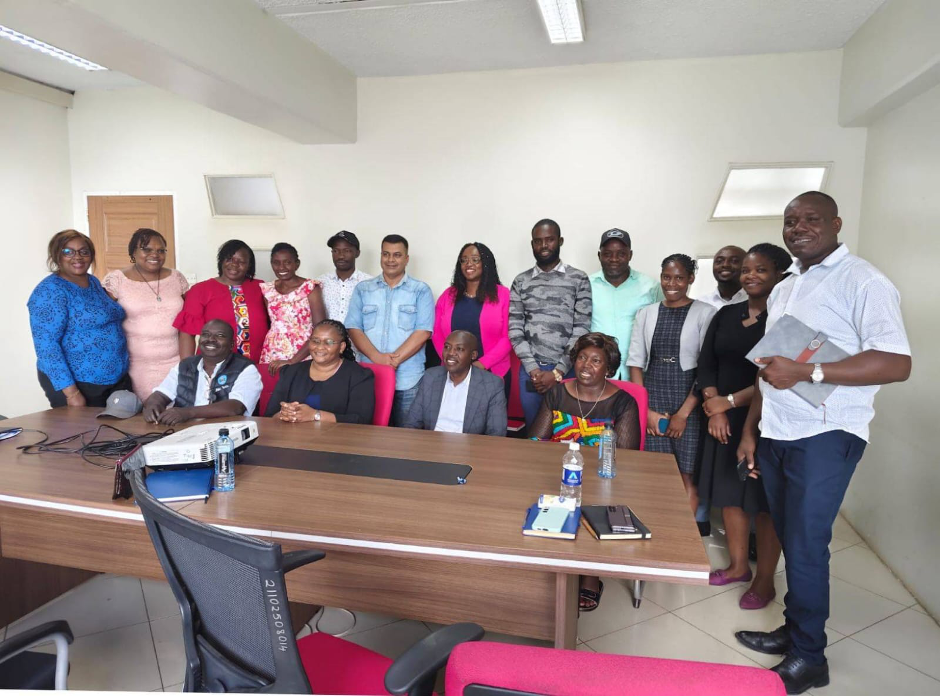
From the left Richard Kainika (KAWR), Sharang Ambadkar (IPI), Shabbir Noormohamed (My-Plastics Ltd.), Joan Maitai ( DRC),  Josphine Kawira (DRC), Hellen Chege (DRC), Kaguchia Anthony (KAWR),  Yasin Abukar(My-Plastics Ltd.), Dr. Sameer Joshi( IPI).

India’s well-established Extended Producer Responsibility (EPR) framework also provides valuable insights. Its structure has supported the recycling ecosystem while considering the economic realities of different categories of enterprises. With Kenya’s renewed momentum following the lifting of the order affecting EPR implementation on 20th November 2025, such international perspectives can inform the country’s evolving EPR practices and strengthen its approach to inclusive and efficient implementation.

KAWR and IPI expressed their commitment to developing a memorandum of understanding focused on technical knowledge exchange. With IPI’s long-standing expertise, Kenya stands to benefit from innovative and practical solutions suited to its waste-management landscape. Additionally, leveraging IPI’s global networks may help elevate Kenya’s visibility in international sustainability platforms. There was also interest in exploring opportunities for Kenya to host major global forums on plastics.

Dr. Sameer encouraged KAWR to expand regional collaboration with similar bodies across East Africa. He emphasized that cooperation in market development, knowledge exchange, and capacity building would strengthen regional sustainability efforts and enhance Kenya’s leadership profile within the circular economy space.

The forthcoming non-profit memorandum of understanding will provide a structured framework for partnership, aimed at raising the capabilities, capacities, and overall quality of Kenya’s waste-management sector. The Secretary General of KAWR, Mr. Richard Kainika, reaffirmed the association’s commitment to working with institutions whose strategic objectives align with its mission of advancing sustainable waste management in the country.

KAWR held an EPR Compliance Workshop on 5th Dec 2025 at Best Western Plus Meridian Hotel, Nairobi. The Event, which was themed “Shaping the Future of EPR: Building Strong Systems and Clear Compliance Processes for Recyclers,” was convened in response to the evolving EPR landscape, which included the protracted legal case and the ensuing conservatory Order against EPR implementation, which was lifted on 20 November 2025.

The case (ELC EP PET/EOO3/2025), however, is still valid but transferred to the Nairobi Environment Court, where it is scheduled to be mentioned on 8th December 2025 for further directions. Against this backdrop, KAWR convened this session to align waste value chain players with the compliance requirements under the EPR Regulation (2024) and to embed clear structures in their businesses to ensure a systematic transition that will translate into long-term sustainability. The stakes couldn’t be higher; the recycling industry truly hinges on how well the sector will adapt to the EPR Framework.

In Photo; Dr. Ayub Macharia from NEMA making his presentation in the forum.

The National Environment Management Authority (NEMA), through the Director of Enforcement, Dr. Ayub Macharia, expounded in great depths the compliance requirements recycling businesses must have moving forward. From licensing requirements, digital traceability features for waste transport, transparent and auditable records, segregation requirements during waste transportation, and declaration obligations, the emphasis was clear: compliance is no longer optional. It is the yardstick that will determine the sector’s longevity and continued success, and it positions recycling as one of the most critical pillars in Kenya’s circular economy agenda.

However, despite the anticipated EPR Subsidies meant to support the actors in the waste management sector, the Dr. Macharia highlighted some key challenges that have hindered this, with the major one being the lack of commitment from producers to meet their EPR Obligation as provided in section 13 of the Sustainable Waste Management (SWM) Act, 2022. Though many producers have declared to fulfill these obligations via a compliance scheme (Producer Responsibility Organization), many remain freeloaders in these schemes, and their responsibility, consequently, is shouldered by a few responsible producers. NEMA, in response, have introduced more stringent measures which will include direct prosecution of retailers who shelve products from non-compliant producers. Advance warnings have been issued to major retail outlets, with crackdowns expected from 1st  February, 2026.

The transition to the National Waste Information System as provided under section 8 of the SWM Act, 2022 which mandates NEMA to “Establish a national waste information system for recording, collecting, managing, and analyzing data, including the quantity and classification of waste, a register of licensed waste operators, status of waste management activities, impact on health and environment, county-level services, compliance information, and other data necessary for effective administration” was also an issue many players in the sector sought clarity on. Peter Gitonga, Managing Director CSharp Ngulu Limited; the entity appointed by NEMA to develop the system, shared the prototype specifications of the system. The comprehensive nature of the system was apparent which automates traceability of waste material flow right from the post-consumer stage right to the point of reintegration(for recyclables) and final disposal for non-recyclables. The system is inextricably linked with compliance at material flow traceability and reporting through the various waste management stages is only possible via compliant waste actor across the various jurisdiction. Since the system will be central to EPR subsidization processes, the need for strong organizational structures and compliance in waste-value chain businesses was further underscored.

And while some few components of the system remain unclear and exposed to risk of manipulation and erroneous data entry, especially at the consumer stage, its overall shape, structure, and comprehensive approach demonstrated the capacity to redefine the waste management sector for the better. Embracing technology and digitization in the waste management sector was a call repeatedly reiterated in the workshop.

The EPR Fee calculation published by NEMA listed some parameters to be included for EPR Fee determination. The general formula for calculating the EPR fee in Kenya could be simplified as follows:-

EPR fee = Cost of (waste handling + waste processing/product chemistry + waste disposal + Enablers) x Quantity.

For this formula to be representative and fair for the sector, it is imperative for the people who are in the waste management sector to interrogate the Market Cost Indexes, which will be used for EPR Fee calculation for the various waste fractions, in order to safeguard accuracy and precise representation. KAWR, as the national umbrella body for the entire waste value chain actors had been tasked by NEMA to develop accurate market indexes for various waste fractions for the said purpose. The session offered a crucial chance for participants to examine and interrogate the market indexes KAWR had developed, as well as complement and refine KAWR’s proposition to ensure the final submission would be an accurate representation of the sector.

The Association is still receiving responses from waste value chain actors regarding the stated objective. Any proposals on the Market Cost Indexes may be submitted to info@kenyarecyclers.co.ke  no later than 11th December 2025. Additional details on the project can also be requested through the same contact.

JiPay, a fintech innovation company showcased their automated micro-savings platform designed to help users save seamlessly through routine mobile transactions. Their solution supports financial discipline and inclusion, particularly for individuals and small enterprises in informal sectors. Their presence added valuable insight into how technology can streamline financial flows within the waste value chain.

The Kenya Association of Waste Recyclers (KAWR) has placed recycling education and public sensitization at the core of its mandate. As the premier (BMO) business membership organization for Kenya’s private-sector waste management and recycling, KAWR works to empower the recycling value chain, advocate for supportive policies, and connect recyclers to markets. This focus on awareness and capacity building has positioned KAWR as a leader in advancing the country’s transition to a circular economy.

Against this backdrop, KAWR is joining the world in marking Global Recycling Week, an annual commemoration that amplifies the mission of reducing waste, conserving resources, and inspiring citizens to take responsibility for what they consume and discard. The week serves as a global platform to highlight innovations, celebrate grassroots recyclers, and rally public action toward a more sustainable future.

This year in Kenya, KAWR is championing the national rallying call:

“Mixing Creates Waste, Sorting Creates Opportunities — Join the Recycling Movement!”

This slogan underscores the fact that waste only becomes valuable when it is separated at source. Mixing destroys material value and clogs recycling systems, while sorting unlocks opportunities—jobs, cleaner neighborhoods, new enterprises, and a thriving circular economy. The call to “join the movement” extends beyond recyclers to every household, institution, and business, inviting all Kenyans to become active participants in transforming the waste landscape.

To bring this message to life, KAWR has lined up a week of activities aimed at sensitizing the public, training grassroots groups, and showcasing the economic potential of sorting at source. The kickoff took place on 23rd September 2025 with a KAWR team led by Sylvia Ochiba, KAWR’s Administration and partnership officer, who visited Mukuru Integrated CBO in Embakasi East. This community-based organization brings together 20 youth groups engaged in waste management at the source, demonstrating how local champions are converting challenges into opportunities despite threats of eviction and limited infrastructure.

Throughout Global Recycling Week, KAWR will continue to amplify stories like Mukuru Integrated CBO’s and roll out community engagement forums, media campaigns, and partnerships with local governments and private sector players to scale up source separation and recycling initiatives, culminating with a national virtual public townhall where experts will delve into the subject.

KAWR calls on all stakeholders—households, businesses, institutions, and government agencies—to rise up and join the recycling movement. By sorting at source, every Kenyan can play a role in reducing waste, creating livelihoods, and advancing a cleaner, greener, and more inclusive economy.

As Extended Producer Responsibility (EPR) frameworks reshapes the landscape of waste
management, a new chapter of responsibility unfolds across industries, communities, and
governments. No longer are waste recyclers or municipal entities alone in bearing the
burden of waste disposal costs—EPR has transferred the liability to producers, putting
onus on them to manage the life cycle of their products. This shift is necessary as well
brings new challenges and opportunities for innovation. As the Secretary General of the
Kenya Association of Waste Recyclers (KAWR), I’d like to reflect on how innovation might
relieve some of the cost pressures inherent in sustainable waste disposal, and explore how
far and deep the journey toward these remedies might take us.
The Need for Innovation in the EPR Era
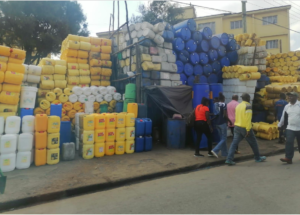

Figure 1:Apacking Reuse market in downtown Nairobi

With EPR policies, producers are required to integrate end-of-life management costs into
their product pricing. As a result, we are witnessing increased scrutiny on the entire value
chain—from material selection, design to disposal and recycling. This shift is critical for
creating a more circular economy but comes with significant financial implications,
particularly for small and medium-sized producers who will struggle with the added
expense of sustainable waste management.

Here, innovation becomes essential. The introduction of smart, cost-effective waste
management technologies can reduce the financial strain on producers and ultimately
benefit all stakeholders in the circular economy. In Kenya, where recycling and waste
management sectors are still developing, we need an innovative ecosystem that addresses
local constraints, encourages collaboration and optimizes both human and financial
resources.

Recycling Education and Public Sensitization
It is common to think of technology every
time we have an issue requiring innovation,
but there is a lot that can be achieved
through educating communities on best
practice in waste management, particularly,
a consumer who is educated will conserve
the value/purity of a packaging by
separating it from contaminants, will seek to
reuse/utilize a packaging before finally
putting it into the bin. These simple acts
could make a huge difference in lowering
the costs of collection,processing and
recycling. More can be achieved through
influencing consumer behavior, for instance, rinsing and folding or compressing a
packaging before binning.Finally, opening up the recycling market to the public through
dissemination on the value of recyclables in areas with low awareness outreach.

Leveraging Technology to Reduce Disposal Costs
Advanced technologies, like AI and IoT, offer promising solutions to alleviate the financial
burdens of sustainable waste disposal. For instance, data analytics can help producers


Figure 2:An innovative approach to solving disposal of

problematic waste PET straps into tea harvesting baskets,
as showcased here by Pura Terra Recycling Ltd in Nairobi
and recyclers gain insight into material recovery rates, predict contamination issues, and
manage collection routes more efficiently. Integrating these systems can lead to greater
precision in waste management, minimizing both time and cost. Such technologies,
however, require initial investment, training, and continued support, which may seem
prohibitive to many stakeholders without government and private sector partnerships to
bridge the gap.

Blockchain technology also stands out as a revolutionary tool for EPR. Through blockchain,
producers and recyclers could track the lifecycle of every item from production to disposal,
ensuring transparency and accountability while minimizing compliance costs. This could
lead to reduced instances of waste leakage and improved accuracy in waste audits,
ultimately making sustainable disposal less costly.
Design Innovation for a Circular Economy
EPR encourages producers to rethink how products are designed, fostering a shift toward
eco-friendly materials that are easier and cheaper to recycle or dispose of sustainably.
Design innovation can be particularly impactful in reducing the total costs associated with
waste disposal.

For example, modular design can make it easier to disassemble and reuse materials from
complex products i.e electronics, and automotive ps etc. In addition, Mono or (single-type)
polymers facilitate recycling, which is more cost-effective and efficient than managing
composite/laminates/multi-layered materials. These design approaches, while demanding
substantial research and development, could reduce the volume and complexity of waste
that recyclers need to process, driving down costs for producers in the long term.

Financing and Public-Private Partnerships
To make these innovations accessible and economically viable, we need strong public-
private partnerships that offer financial incentives, subsidies, and funding for research and
development. Grants, tax breaks, and low-interest loans can provide vital support to
smaller companies and other prospective sector investments eager to implement
sustainable waste management solutions struggling with the cost.
Moreover, Community-Based Recycling Initiatives(CBRI)- like CBOs doing collective waste-
picking networks- can gain traction and scale with proper financing. Such initiatives tap
into local resources and, with the support of EPR frameworks, can contribute substantially
to circularity while keeping costs down.

How Deep and How Far Should We Go?
The journey to reduce the financial burden is both broad and complex. It requires a deep-
rooted commitment to building a circular economy that prioritizes eco-friendly design,
public sensitization, efficient processing, and robust policy enforcement. To meet these
demands, we must be prepared to invest in research, foster collaboration across sectors
and advocate for policies that support innovative solutions.

From Kenya Association of Waste Recyclers’s (KAWR) perspective, we aim to champion this
cause by engaging stakeholders in meaningful dialogues, advocating for policies that
support innovation, and collaborating with government agencies to create an enabling
environment for sustainable waste management. This journey may seem daunting, yet it’s
vital. We need a comprehensive approach that not only addresses the cost barriers today
but also lays the groundwork for a more circular, resilient future.

In conclusion, the EPR era calls upon us to rethink our responsibilities, innovation, and
investment in long-term solutions that support sustainable waste management. With
collaboration and a shared commitment to the circular economy, innovation can serve as
the key that unlocks more efficient, affordable, and sustainable waste disposal options for
producers, consumers, and recyclers alike. As Kenya navigates this journey, KAWR stands
ready to support, advocate, and lead the way. The challenge is vast, but the potential is
greater.

Let’s embrace this opportunity to redefine what’s possible in sustainable waste
management. The future demands it, and together, we can meet that call.
Richard Kainika
Nairobi 2024